
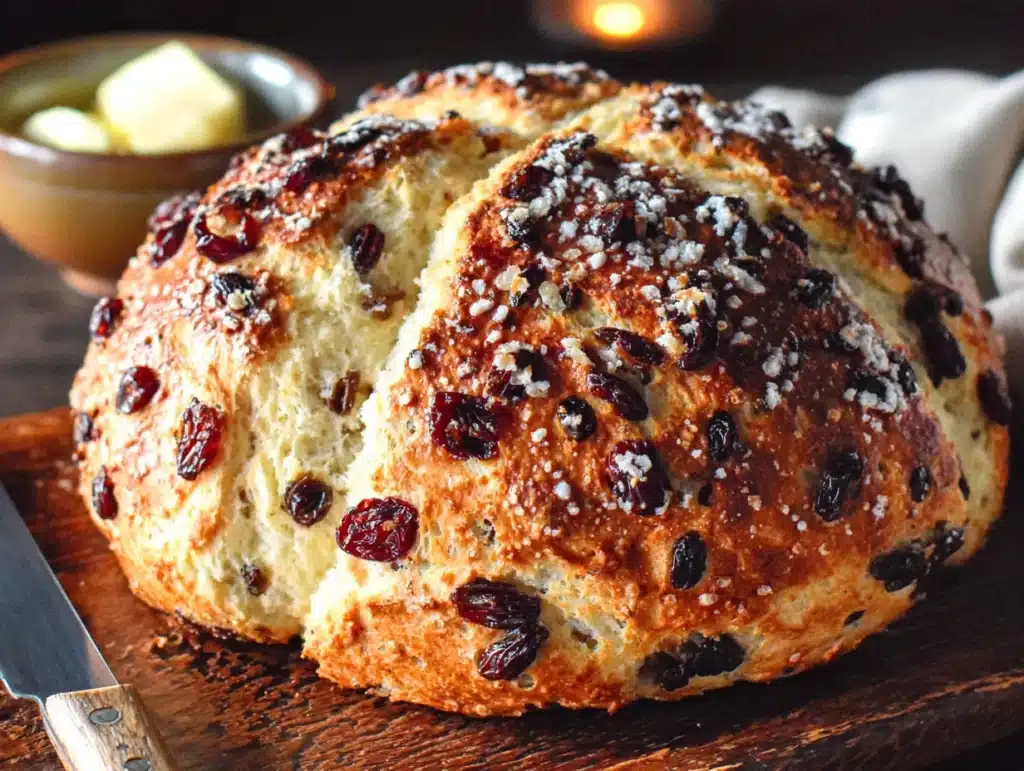
I swore I hated caraway seeds. For years. I’d pick them out of rye bread with the precision of a surgeon, leaving little craters behind. Then one rainy Tuesday, I found myself at my neighbor Maggie’s kitchen table, and she shoved a slice of warm Irish soda bread at me. I was too polite to refuse. I took a bite—and there they were. Those little seeds I’d spent a lifetime avoiding. But something was different. The butter had melted into the crumb, the raisins were soft and sweet, and the caraway? It wasn’t bossy. It was subtle, earthy, almost cozy. I ate two more slices before admitting defeat. Maggie just smiled. She knew.
That’s the thing about this Irish soda bread. It doesn’t try to convince you. It just sits there, all golden and rustic, waiting for you to come around. And you will. I mean, honestly, I’ve made this recipe at least a dozen times since that rainy afternoon, and it gets better every single time. The crust gets that perfect crackly top, the inside stays tender but not cakey, and the whole kitchen smells like a warm hug from an Irish grandmother you never knew you had.
Maybe you’ve been there—skeptical of a simple bread, thinking it couldn’t possibly be that good. But this one is different. It’s the kind of bread that makes you slow down, that begs for a pat of butter and a cup of strong tea. It’s not fancy, and that’s precisely the point. It’s honest food. And honestly? It changed my mind about caraway forever.
Why You’ll Love This Recipe
Let me tell you why this soda bread has earned a permanent spot in my kitchen rotation. I’ve tested it on picky eaters, on bread purists, and on people who swore they “didn’t like raisins in bread.” Every single one asked for the recipe.
- Quick & Easy: From mixing bowl to oven in under 15 minutes. No kneading, no rising, no fuss. This is the bread you make when you want fresh bread right now.
- Simple Ingredients: You probably have everything in your pantry already. Flour, buttermilk, baking soda, salt, raisins, and caraway seeds. That’s it. No yeast, no starter, no special trip to the store.
- Perfect for Cozy Evenings: This bread was made for cold weather, rainy afternoons, and days when you need something warm and comforting. It pairs beautifully with soup, stew, or just a generous smear of salted butter.
- Crowd-Pleaser: I’ve brought this to potlucks and watched it disappear before the main course. Kids love the sweet raisins, adults appreciate the savory caraway, and everyone loves the tender crumb.
- Unbelievably Delicious: The texture is what gets me every time. That craggy, golden crust gives way to a soft, almost scone-like interior studded with plump raisins and fragrant caraway. It’s next-level comfort food, I swear.
What makes this recipe different from the dozens of others out there? It’s the ratio. I spent a frustrating weekend testing batches that were too dry, too dense, or too cakey. This version hits that sweet spot—tender enough to eat plain, sturdy enough to hold up to a thick slather of butter. The buttermilk gives it a subtle tang that balances the sweetness of the raisins, and the caraway adds just enough complexity to keep you coming back for another bite.
This isn’t just good bread. It’s the kind that makes you close your eyes after the first bite. It’s comfort food reimagined—simpler, faster, but with the same soul-soothing satisfaction. Perfect for impressing guests without breaking a sweat, or turning a rainy Tuesday into something special.
What Ingredients You Will Need
This recipe uses simple, wholesome ingredients to deliver that classic Irish soda bread flavor. Most of these are pantry staples, which is exactly why this bread is so brilliant—you can make it on a whim without a grocery run.
For the Bread
- All-purpose flour, 3 ½ cups (440g) – I use King Arthur Flour for consistent results, but any good all-purpose flour works. Don’t use bread flour; it will make the bread too tough.
- Granulated sugar, 2 tablespoons (25g) – Just enough to balance the tangy buttermilk and complement the raisins. Not enough to make it sweet, just enough to round it out.
- Baking soda, 1 teaspoon – This is your leavening agent. Make sure it’s fresh—test it by dropping a pinch into vinegar; it should fizz vigorously.
- Salt, 1 teaspoon – I prefer fine sea salt. It distributes more evenly than coarse salt in a quick-mix dough.
- Unsalted butter, 4 tablespoons (56g), cold and cubed – The butter should be straight from the fridge. You want it to stay solid as you work it into the flour, creating those little pockets of tenderness. I use Kerrygold when I’m feeling fancy.
- Caraway seeds, 1 ½ teaspoons – This is where the magic happens. If you’re a caraway skeptic (I was you!), start with 1 teaspoon. But trust me, the full amount is perfect. The seeds soften slightly during baking and become pleasantly aromatic rather than overpowering.
- Raisins, 1 cup (150g) – I use Thompson raisins for their plumpness and sweetness. Golden raisins work too, but they’re a bit milder. If your raisins are dry, soak them in hot water for 10 minutes, then drain and pat dry before using.
- Buttermilk, 1 ½ cups (360ml), cold – This is non-negotiable. The acidity in buttermilk reacts with the baking soda to create lift. If you don’t have buttermilk, you can make a quick substitute: add 1 ½ tablespoons of lemon juice or white vinegar to 1 ½ cups of milk, stir, and let it sit for 5 minutes.
For the Topping

- Egg, 1 large – For the wash. It gives the crust that gorgeous golden-brown sheen.
- Water, 1 tablespoon – To thin the egg wash.
- Coarse sea salt or caraway seeds, for sprinkling (optional) – A little sprinkle on top before baking adds a lovely visual and textural finish.
I’ve made this bread with both salted and unsalted butter, and I honestly prefer unsalted here because it lets me control the salt level. The caraway seeds are worth seeking out—they’re usually in the spice aisle near the poppy seeds. And if you’re wondering, yes, you can use dried currants instead of raisins. They’re smaller and slightly tarter, which some people prefer.
Equipment Needed
One of the things I love most about this recipe is how little equipment it requires. No stand mixer, no bread machine, no fancy gadgets. Just the basics.
- Large mixing bowl – You need room to get your hands in there. I use a wide ceramic bowl that gives me plenty of space to work.
- Whisk – For combining the dry ingredients evenly before adding the butter.
- Pastry cutter or two forks – For cutting the butter into the flour. You can also use your fingertips, but a pastry cutter is faster and keeps the butter from warming up too much.
- Bench scraper or spatula – For folding the dough together. A rubber spatula works fine.
- Baking sheet – Line it with parchment paper for easy cleanup. I’ve used a cast iron skillet too, and it works beautifully—the hot pan gives the bottom crust an extra-crispy texture.
- Sharp knife or lame – For scoring the top. A serrated knife works best; it cuts cleanly without dragging the dough.
- Pastry brush – For the egg wash. If you don’t have one, use a folded paper towel.
- Cooling rack – Essential for preventing a soggy bottom. I learned this the hard way.
If you don’t have a pastry cutter, honestly, two forks crossed and pulled apart does the same job. And if you don’t have a baking sheet, a cast iron skillet or even a cake pan will work—just adjust the baking time slightly.
Preparation Method
Let me walk you through this step by step. I’ve made this bread more times than I can count, and I’ve learned a few tricks along the way.
- Preheat your oven to 400°F (200°C). Place a rack in the middle position. Line a baking sheet with parchment paper. Get this done first—the dough comes together fast, and you want the oven ready to go.
- Whisk the dry ingredients. In your large mixing bowl, combine 3 ½ cups (440g) all-purpose flour, 2 tablespoons (25g) sugar, 1 teaspoon baking soda, and 1 teaspoon salt. Whisk thoroughly for about 15 seconds. This ensures the baking soda and salt are evenly distributed—no bitter pockets of baking soda in your finished bread.
- Cut in the butter. Add the 4 tablespoons (56g) of cold, cubed butter to the flour mixture. Using your pastry cutter or two forks, cut the butter into the flour until the mixture resembles coarse meal with pea-sized butter pieces. Some smaller bits are fine, but you want visible butter flecks. This is what creates that tender texture. Work quickly so the butter stays cold.
- Add the caraway and raisins. Sprinkle 1 ½ teaspoons caraway seeds and 1 cup (150g) raisins over the flour mixture. Toss gently with your hands or a fork to distribute them evenly. Don’t overmix—you just want them coated in flour so they don’t sink to the bottom during baking.
- Make a well and add buttermilk. Create a well in the center of the flour mixture. Pour in 1 ½ cups (360ml) cold buttermilk all at once. Using a spatula or your hands, gently fold the flour into the buttermilk. Mix just until the dough comes together. It will look shaggy and a bit messy—that’s exactly what you want. Overmixing will make the bread tough.
- Turn out and shape. Lightly flour your work surface. Turn the dough out and gently bring it together with your hands. Don’t knead it—just pat it into a round dome about 7 inches (18 cm) in diameter and 2 inches (5 cm) high. The surface should be craggy and irregular. That rustic look is part of the charm.
- Transfer to baking sheet. Place the dough on your prepared baking sheet. If you want a slightly crisper bottom crust, you can dust the parchment with a little cornmeal first.
- Score the top. Using a sharp knife or lame, cut a deep cross into the top of the dough, about ½ inch (1.25 cm) deep. This isn’t just decorative—it’s functional. It helps the bread expand evenly during baking and allows the heat to penetrate the center. In Irish tradition, it’s also said to “let the fairies out.” I like that.
- Apply egg wash. In a small bowl, whisk the egg with 1 tablespoon of water. Brush this mixture over the entire surface of the dough, getting into the crevices of the cross. Sprinkle with a few extra caraway seeds or a pinch of coarse sea salt if you like.
- Bake. Place the baking sheet in the preheated oven. Bake for 35-40 minutes, until the bread is deep golden brown and sounds hollow when tapped on the bottom. The internal temperature should reach 190°F (88°C) if you want to be precise. I usually check at 35 minutes and add more time if needed.
- Cool. Transfer the bread to a wire rack. Let it cool for at least 20-30 minutes before slicing. I know it’s tempting to cut into it right away, but the steam needs to settle. Cutting too early will give you a gummy texture. Trust me, I’ve done it. Many times.
A few notes from my kitchen: If your dough feels too dry and won’t come together, add buttermilk one tablespoon at a time. If it’s too sticky, add a sprinkle of flour. The dough should be soft and slightly tacky, not wet. And don’t worry if it looks lumpy—soda bread is supposed to look rustic. Perfectly smooth soda bread is suspicious soda bread.
Cooking Tips & Techniques
Over the years, I’ve learned a few things the hard way so you don’t have to. Here are my best tips for perfect Irish soda bread every time.
Keep everything cold. This is the single most important tip. Cold butter, cold buttermilk, cold hands if possible. Warm ingredients will make the butter melt into the flour instead of staying in little pieces, and you’ll end up with a dense, flat bread. I’ve even popped my mixing bowl in the fridge for 10 minutes before starting on a hot day.
Don’t overmix. I cannot stress this enough. Mix until the dough just comes together—stop when you don’t see any more dry flour. Overworking the dough develops gluten, and you’ll end up with tough, chewy bread instead of tender, crumbly soda bread. It should look rough and shaggy. Embrace the mess.
Use a serrated knife to slice. A straight blade will crush the tender crumb. A serrated knife saws through cleanly, preserving that beautiful texture. I learned this after mangling my first loaf.
Toast leftover slices. Day-old soda bread is perfect for toasting. The heat brings back the tenderness and crisps up the edges. It’s actually my favorite way to eat it—with a generous layer of butter that melts into all the nooks and crannies.
Check your baking soda. If your bread doesn’t rise properly or has a bitter taste, your baking soda is likely old. Test it before you start: drop a pinch into a bowl of vinegar. If it fizzes enthusiastically, you’re good. If it barely reacts, buy fresh.
Let it cool properly. I know the smell is intoxicating. But cutting into warm soda bread before it’s fully set will give you a gummy, doughy center. Give it at least 20 minutes. Use that time to make tea and get the butter to room temperature.
One failure I’ll share: I once forgot the baking soda entirely. The bread came out flat, dense, and about as appealing as a hockey puck. My husband ate it anyway, bless him, but I learned to double-check my ingredients before mixing. It’s a simple mistake, but it taught me to respect the chemistry.
Variations & Adaptations
This recipe is wonderfully adaptable. Here are some variations I’ve tried and loved.
Classic Plain Soda Bread
Omit the raisins and caraway seeds for a traditional Irish brown soda bread. It’s perfect for serving with hearty stews or soups. Add an extra tablespoon of butter to compensate for the missing moisture from the raisins.
Savory Herb Version
Swap the raisins for ½ cup (50g) of grated sharp cheddar cheese and add 1 teaspoon of dried rosemary and 1 teaspoon of dried thyme. Omit the caraway or keep it—both work. This version is incredible alongside a bowl of tomato soup.
Gluten-Free Option
Use a 1:1 gluten-free flour blend that contains xanthan gum. I’ve had good results with Bob’s Red Mill Gluten-Free All-Purpose Flour. The texture will be slightly more crumbly, so handle the dough gently. Add an extra tablespoon of buttermilk if the dough seems too dry.
Vegan Version
Replace the butter with cold coconut oil or vegan butter. Use unsweetened almond milk or oat milk mixed with 1 ½ tablespoons of lemon juice instead of buttermilk. Skip the egg wash and brush the top with a little plant-based milk before baking.
Dried Fruit Medley
Instead of just raisins, use a mix of dried cranberries, chopped dried apricots, and golden raisins. The tartness of the cranberries balances the sweetness beautifully. I made this for Thanksgiving one year and it was gone in minutes.
Whole Wheat Version
Replace half the all-purpose flour with whole wheat flour. You’ll need to add an extra 2-3 tablespoons of buttermilk because whole wheat flour absorbs more liquid. The bread will be denser and nuttier, with a lovely earthy flavor.
I’ve tried the cheddar-herb version myself, and honestly, it’s become my go-to for fall gatherings. The cheese gets all melty and browned on the edges, and the rosemary makes the whole kitchen smell like a cozy pub. It’s a crowd-pleaser every time.
Serving & Storage Suggestions
This Irish soda bread is at its absolute best the day it’s made, served warm with a generous pat of salted butter. The butter melting into the tender crumb is pure magic.
Serving temperature: I prefer it slightly warm, but room temperature is lovely too. If you’re serving it alongside soup or stew, warm it briefly in a 300°F (150°C) oven for 5-7 minutes. Don’t microwave it—it will turn rubbery.
What to serve with it: This bread is incredibly versatile. It’s perfect with:
- A bowl of hearty Irish stew or beef and Guinness stew
- Butternut squash soup or tomato basil soup
- Smoked salmon and cream cheese for a fancy brunch
- Sharp cheddar cheese and apple slices for a simple lunch
- Jam, honey, or marmalade for breakfast
- A generous smear of salted butter and a cup of strong black tea
Storage: Store leftover soda bread wrapped in a clean kitchen towel or paper bag at room temperature for up to 2 days. Do not store it in plastic—it will trap moisture and make the crust soft and sad. If the crust gets too hard, wrap it in a damp paper towel and warm it in the oven for a few minutes.
Freezing: This bread freezes beautifully. Wrap the completely cooled loaf tightly in plastic wrap, then in foil. Freeze for up to 3 months. To thaw, leave it at room temperature for a few hours, then warm it in a 350°F (175°C) oven for 10-15 minutes. The texture will be almost as good as fresh.
Reheating: The best way to revive day-old soda bread is to slice it and toast it. The toaster brings back the crispy crust and soft interior. For whole slices, I pop them in a toaster oven at 350°F (175°C) for 3-4 minutes.
One thing I’ve noticed: the flavors actually meld and deepen after a day. The caraway becomes more subtle, the raisins plump up a bit more, and the tang from the buttermilk mellows. Second-day soda bread, toasted with butter, might actually be better than fresh. Don’t tell Maggie I said that.
Nutritional Information & Benefits
Here’s the estimated nutritional breakdown per slice (based on 12 slices):
| Nutrient | Amount per slice |
|---|---|
| Calories | 215 |
| Total Fat | 5g |
| Saturated Fat | 3g |
| Cholesterol | 25mg |
| Sodium | 310mg |
| Total Carbohydrates | 38g |
| Dietary Fiber | 2g |
| Sugars | 10g |
| Protein | 5g |
This bread offers some surprising benefits. Raisins are packed with antioxidants and provide a natural energy boost. Caraway seeds have been used for centuries to aid digestion—they’re known for their carminative properties, which means they help reduce bloating. The buttermilk adds calcium and probiotics (if you use cultured buttermilk). And since there’s no yeast, this bread is easier to digest for some people who are sensitive to yeast.
Dietary considerations: This recipe is vegetarian. It contains gluten, dairy, and eggs. For a dairy-free version, use the vegan substitutions mentioned above. For a lower-sugar option, reduce the raisins to ½ cup or use unsweetened dried cranberries.
I personally love that this bread feels indulgent but isn’t loaded with sugar or fat. One slice with butter is satisfying enough to keep me from reaching for a second piece of cake. It’s comfort food that doesn’t leave me feeling heavy.
Conclusion
This Irish soda bread with raisins and caraway has become a staple in my kitchen, and I think it deserves a spot in yours too. It’s the bread you make when you want something warm and homemade but don’t have hours to spend kneading and waiting. It’s the bread that fills your home with the kind of smell that makes everyone wander into the kitchen asking, “What’s baking?”
I love that this recipe is forgiving. You can add more raisins, skip the caraway, swap in different dried fruits, and it will still be delicious. It’s a recipe that invites experimentation rather than demanding precision. And honestly, that’s rare in baking.
So go ahead—make a loaf this weekend. Slice it while it’s still warm, slather it with good butter, and pour yourself a cup of tea. Take a bite and let yourself be converted. I was, and I haven’t looked back since that rainy Tuesday at Maggie’s table.
If you try this recipe, I’d love to hear how it turned out. Leave a comment below and let me know if you were a caraway skeptic too. And if you added your own twist, share that as well—I’m always looking for new ideas. Happy baking, friends!
Frequently Asked Questions
Why did my soda bread turn out dense and heavy?
This usually happens from overmixing the dough. Soda bread should be mixed just until the ingredients come together—no kneading, no vigorous stirring. Overworking the dough develops gluten, which makes it tough. Also check that your baking soda is fresh; old baking soda won’t provide enough lift.
Can I use regular milk instead of buttermilk?
You can, but you need to acidify it first. The acidity in buttermilk is what reacts with the baking soda to create rise. Add 1 ½ tablespoons of lemon juice or white vinegar to 1 ½ cups of regular milk, stir, and let it sit for 5 minutes. It will curdle slightly—that’s normal and exactly what you want.
How do I know when the bread is fully baked?
The bread should be deep golden brown on top and sound hollow when you tap the bottom. If you have an instant-read thermometer, the internal temperature should be 190°F (88°C). If the top is browning too quickly but the center isn’t done, tent the loaf loosely with foil for the last 10 minutes of baking.
Can I make this bread ahead of time?
Soda bread is best the day it’s made, but you can bake it a day ahead. Store it wrapped in a kitchen towel at room temperature. To refresh it, warm slices in a toaster or the whole loaf in a 350°F (175°C) oven for 5-7 minutes. You can also freeze the baked loaf for up to 3 months.
Can I skip the caraway seeds?
Absolutely. The caraway adds a distinct flavor, but the bread is still delicious without it. If you’re unsure, start with just 1 teaspoon, or omit it entirely and add an extra ½ teaspoon of salt to balance the flavors. The raisins alone make this bread wonderful.
Pin This Recipe!

Cozy Irish Soda Bread with Raisins: Easy Homemade Recipe
This easy Irish soda bread with raisins and caraway seeds is tender, rustic, and ready in under an hour. Perfect for cozy evenings, it pairs beautifully with soup, stew, or a generous smear of salted butter.
- Total Time: 50-55 minutes
- Yield: 12 servings 1x
Ingredients
- 3 ½ cups (440g) all-purpose flour
- 2 tablespoons (25g) granulated sugar
- 1 teaspoon baking soda
- 1 teaspoon fine sea salt
- 4 tablespoons (56g) unsalted butter, cold and cubed
- 1 ½ teaspoons caraway seeds
- 1 cup (150g) raisins
- 1 ½ cups (360ml) cold buttermilk
- 1 large egg (for egg wash)
- 1 tablespoon water (for egg wash)
- Coarse sea salt or caraway seeds for sprinkling (optional)
Instructions
- Preheat oven to 400°F (200°C). Line a baking sheet with parchment paper.
- In a large bowl, whisk together flour, sugar, baking soda, and salt.
- Cut in cold butter using a pastry cutter or two forks until mixture resembles coarse meal with pea-sized butter pieces.
- Add caraway seeds and raisins; toss gently to coat.
- Make a well in the center and pour in cold buttermilk. Fold with a spatula or hands until dough just comes together (shaggy is fine).
- Turn dough onto a lightly floured surface and gently shape into a 7-inch round dome, about 2 inches high. Do not knead.
- Transfer to prepared baking sheet. Score a deep cross on top, about ½ inch deep.
- Whisk egg with water and brush over dough. Sprinkle with caraway seeds or coarse salt if desired.
- Bake for 35-40 minutes until deep golden brown and hollow when tapped. Internal temperature should reach 190°F (88°C).
- Cool on a wire rack for at least 20-30 minutes before slicing.
Notes
Keep all ingredients cold for best texture. Do not overmix. Use a serrated knife to slice. Day-old bread is perfect for toasting. Check baking soda freshness before starting.
- Prep Time: 15 minutes
- Cook Time: 35-40 minutes
- Category: Bread
- Cuisine: Irish
Nutrition
- Serving Size: 1 slice
- Calories: 215
- Sugar: 10
- Sodium: 310
- Fat: 5
- Saturated Fat: 3
- Carbohydrates: 38
- Fiber: 2
- Protein: 5
Keywords: Irish soda bread, soda bread with raisins, caraway seed bread, easy bread recipe, no yeast bread, quick bread, homemade bread, comfort food, Irish recipe